


A Journey Through Arthurian Britain
Tales of King Arthur and his Knights of the Round Table have been captivating the imaginations of readers with stirring tales of chivalry, valor, and romance for centuries. But the remarkable number of references in classic Arthurian works to actual locations in Britain have led historians and archaeologists to question the distance between fact and fiction. This sojourn transports you through the beautiful southwestern corner of the British Isles to explore some of the most notable sites of Arthurian lore and investigate their historical and literary connections. As we immerse ourselves in the evocative landscapes of South Wales, Cornwall, and Somerset, together we ponder questions that have enthralled readers for ages. Could there have been a King Arthur? Did Camelot exist? Was there an Excalibur? Join us on this fascinating journey and you may find yourself closer to answering those questions than you ever imagined!
In Morte d’Arthur Thomas Malory reminds readers: “Yet some men say in many parts of England that King Arthur is not dead . . . many men say that there is written upon his tomb this verse: Hic jacet Arthurus, Rex quondam, Rexque futurus (Here lies Arthur, the once and future King)”. Arthur may sleep still, but on this fascinating sojourn we invoke his spirit and engage with a variety of Arthurian texts, both early and late, as we travel through the breathtaking landscapes that inspired them. “Quest” is certainly the essence of Arthurian romance, whether its object is honor, glory, love, or the Holy Grail itself. The settings for the tales are in one sense mythical, but also contain deep roots in the medieval English countryside, a varied and evocative terrain that most certainly informed the psyche of countless writers of Arthurian tales. Our quest is to recover something of the mystery and excitement from both the land and literature by exploring the historical and archaeological evidence behind the legend.
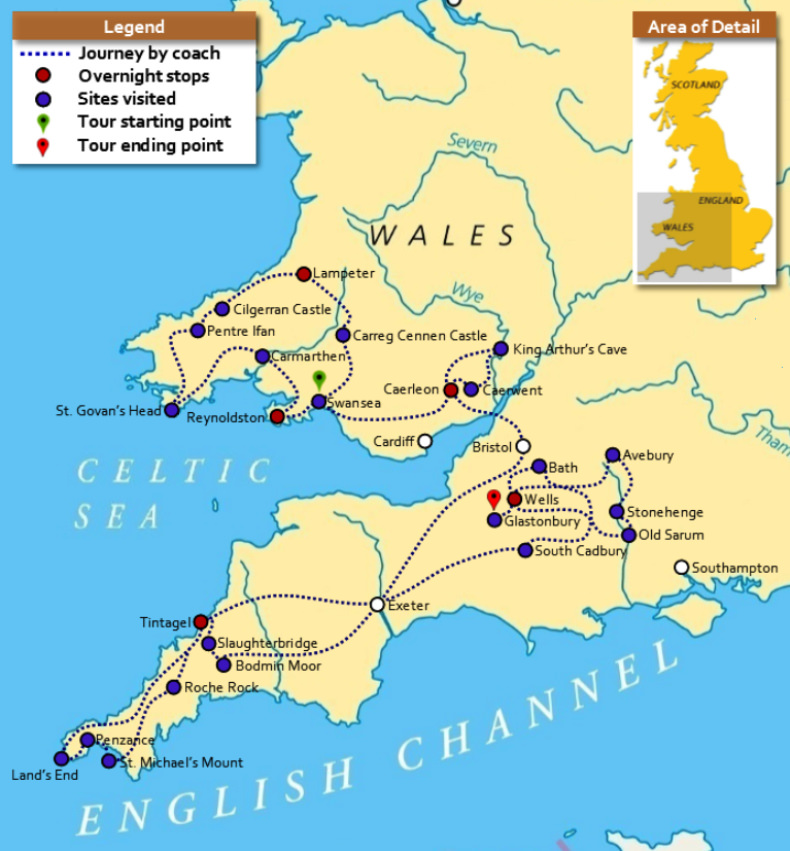
We begin in South Wales, an area redolent with the spirit of Arthurian lore. This is a land of magic and of mystery and these features are also prominent in Welsh Arthurian tales such as Peredur an early version of what would become the Grail legend, and How Culhwch won Olwen with its fanciful catalog of some 200 Arthurian knights. Wales is also the land that supplied the stones used to build Stonehenge – according to Arthurian legend Merlin flew them to the Salisbury Plain from the Prescelly Mountains. Accordingly we journey to Merlin’s legendary birthplace of Carmarthen, visiting several sites associated with him along the way. We also explore one of the most haunting and atmospheric castles in Wales, Carreg Cennen, a place whose very appearance seems to spring from legend. This was the seat of Urien Rheged whose son Owain became one of Arthur’s knights. In French he is called Yvain, the subject of one of the earliest and greatest Arthurian romances. We also travel to Caerleon, according to Geoffrey of Monmouth the site of Arthur’s court, where we explore the finest Roman amphitheatre in Britain. Here we consider Geoffrey’s crucial contribution to the growth of the Arthurian saga as well as the looming presence of the Roman Empire in the early tales. We also take note Tennyson’s important connection to Caerleon and ponder this as we enjoy lunch in the very hostelry where he lodged while writing Idylls of the King in 1856.
Leaving Wales we head south to Cornwall, a most charming and atmospheric region that also abounds with Arthurian associations. We headquarter on the north coast in idyllic town of Tintagel where we overlook the Atlantic Ocean and the spectacularly situated ruins of Tintagel Castle, the legendary site of Arthur’s mysterious conception and birth as recounted in the opening chapters of Morte D’Arthur. From here we journey to the southern coast of Cornwall, stopping at Land’s End where we are able imagine somewhere on the distant horizon the lost land of Lyonesse, Tennyson’s setting for the final battle between Mordred and Arthur. We pass an afternoon on St. Michael’s Mount, the site of a titanic battle between Arthur and a local giant, and the place where Joseph of Arimethea, who brought the Holy Grail to England, once plied his trade as a tin merchant. We also explore several nearby sites associated with the end of the legend including Slaughter Bridge, where Arthur received a mortal wound in battle with his nephew Mordred, and also the Dozmary Pool on Bodmin Moor, where Bedivere, following Arthur’s instructions, reluctantly threw Excalibur back into the water.
From Cornwall we shift our base to the fascinating city of Glastonbury in beautiful Somerset, England. Frequently cited as the location of Avalon, Glastonbury is an absolute mecca of Arthurian lore. Here we explore a number of significant sites including the Chalice Well, where later legend says that the Grail may have been hidden; Glastonbury Abbey, where in 1191 the monk claimed to have discovered the tomb of Arthur and Guinevere; and Glastonbury Tor, which rewards those who climb to its summit with splendid views over the town and surrounding countryside. We also visit nearby Cadbury Castle, site of an Iron Age hill fort that is perhaps the most plausible of candidates for the actual Camelot.
No Arthurian tour would be complete, however, without a visit to Stonehenge, according to Geoffrey built by Merlin to commemorate the burial place of fallen Britons, slain by the Saxons. Here we examine both Arthurian legend and recent theories about the construction and purpose of this megalithic monument. At nearby Old Sarum we encounter another Iron Age hill fort and here we are able walk amongst the ruins while we consider the massive efforts that it would have taken to create. Finally we make a pilgrimage to Winchester, yet another viable candidate for the original Camelot, to visit the Great Hall with its magnificent Round Table, dating to the 13th century, and repainted in its present form during the reign of Henry VIII.
At the conclusion of our sojourn we will surely find ourselves infused with the desire to continue the quest, for in the end the search for Camelot is about aspirations, of what we might become. Its achievement may be fleeting, evanescent, perhaps finally unattainable, but the quest itself always rewards a supreme effort if with nothing more than a richer appreciation for the ideal.
- Enjoy three days in beautiful South Wales and visit both Brecon Beacons and Pembrokeshire Coast National Parks
- Enjoy privately-guided visits to the Roman ruins at Caerleon and Caerwent
- Drive along the Wye River Valley, see Tintern Abbey, and explore King Arthur’s Cave
- Take a private, guided tour of the castle and gardens on St. Michael’s Mount
- An afternoon in the majestic city of Bath —a UNESCO World Heritage City—with time for sightseeing, shopping, and visiting the Roman Baths
- Explore the stunning prehistoric monuments of Stonehenge, Avebury Stone Circle, and Pentre Ifan
- Visit the historic ruins of Carreg Cennen Castle, Cilgerran Castle, and Tintagel Castle
- Experience a Scholarly Sojourns signature picnic in the shadows of Pentre Ifan
- Enjoy a private, guided walking tour of the town of Glastonbury including visits to the Chalice Well and Glastonbury Abbey


Lampeter, South Wales


David Raybin
Professor Emeritus of English
Eastern Illinois University
 David Raybin is Distinguished Professor Emeritus of English at Eastern Illinois University. Prof. Raybin holds a Ph.D. in comparative medieval literature from Columbia University. The main focus of his teaching and scholarship is the writings of Chaucer, with occasional forays into medieval French literature. As a scholar, Prof. Raybin is editor of The Chaucer Review. He has also produced four collections of essays on Chaucer, working in collaboration with his wife Susanna Fein. Their books include Chaucer: Visual Approaches, Chaucer: Contemporary Approaches, Rebels and Rivals: The Contestive Spirit in The Canterbury Tales, and the three-volume edition The Complete Harley 2253 Manuscript. Prof. Raybin has authored dozens of articles and chapters on Chaucer and other medieval subjects, most recently a study of the Becket miracle windows at Canterbury Cathedral. In addition, he has directed many seminars on the Canterbury Tales for the National Endowment of the Humanities. A highlight of these seminars has been a trip along the pilgrimage route from London to Canterbury.
An enthusiastic teacher-scholar, Prof. Raybin was named both Professor Laureate and Distinguished Professor at Eastern Illinois. In 2011 he was honored as Illinois Professor of the Year by the Council for the Advancement and Support of Education and the Carnegie Foundation. In his free time, he travels extensively in Europe and North America. This Active Scholar Sojourn combines two of his greatest pleasures: enjoying Chaucer’s poetry and walking through the English countryside.
DAVID RAYBIN ALSO LEADS THESE SOJOURNS:


Travel Information
MEETING TIME AND LOCATION:
The meeting point for this sojourn is the railway station in Swansea, Wales which is easily reached by either train or bus from both central London and Heathrow Airport. Those making their own travel arrangements should plan to arrive here by noon on Sunday, October 4, 2020. You will be greeted by your Scholarly Sojourns Tour Director who will assist you with boarding our nearby coach for the start of the tour.
OPTIONAL AIR PACKAGE FROM $1,199/PERSON
Our air packages are designed to make all your travel convenient and seamless. They include round-trip, airfare from select North American gateways, airport transfers, and 100% travel assurance.
Recommended Reading:
All participants are highly encouraged to explore the following works as a background to this sojourn:
Le Morte Darthur (Norton Critical Editions)
Mallory, Sir Thomas. W. W. Norton & Company. 2003.
The History of the Kings of Britain
Geoffrey of Monmouth. CreateSpace. 2010.
Idylls of the King.
Tennyson, Alfred. Forgotten Books. 2008.
Yvain: The Knight of the Lion.
Cretien de Troyes & Raffel, Burton. Yale University Press. 1987.
The Lais of Marie de France
Marie de France, Burgess, Glyn S., & Busby, Keith. Penguin Classics. 1999.
FAQs
Q: What kind of weather can I expect in Britain in early October?
Average daytime temperatures will range from mid-50s to low -70’s, but it can get much cooler in the late evenings and night. Rain is also likely at this time of year. Participants should bring a lightweight, waterproof jacket or a small umbrella.
Q: Can I arrive before or remain after the sojourn?
Yes. If you would like to arrive at the start location in advance or remain at the end location after the sojourn has concluded, Scholarly Sojourns can help you arrange your hotel accommodation and is often able to secure attractive rates. This is also a perfect sojourn with which to combine a few days in London either prior to or following the program. Please indicate these preferences to us after you have registered for a particular sojourn.
Q: How much walking will be required on this sojourn?
Some of the archaeological sites we visits require walking up hills and ascending multiple staircases. At a minimum, all participants should be comfortable walking up to a mile at a time and capable of climbing up to three flights of stairs at a time.
Q: I am a single traveler. Can you help me find a roommate?
Scholarly Sojourns will do all we can to match single travelers with a suitable roommate if they desire. But we cannot guarantee that roommates will be available. Therefore all single travelers should register as such and be prepared to pay the single traveler rate should a roommate not be identified.
Q: Is this sojourn appropriate for children?
This sojourn is not appropriate for children, but adolescents aged 14 or older will find the material both engaging and entertaining. They may even get extra credit in their literature class.
Uncovering Camelot: A Journey Through Arthurian Britain
DEPARTURE:
Land price per person (double occupancy): $---
Land price per person (single occupancy): $---
Optional air packages from: * $---
Special Offers:
This Sojourn Combines Nicely With:
Land price per person (double occupancy): $3,295
Land price per person (single occupancy): $3,795
Optional air packages from: * $1,199
Special Offers:
Combination Discount: Save $250/Person and receive a transfer between locations when you book consecutive tours.
This Sojourn Combines Nicely With:
Brewing in Bavaria
Great Castles of Britain
Imagining Middle-earth
Land price per person (double occupancy): $3,395
Land price per person (single occupancy): $3,895
Optional air packages from: * $1,249
Special Offers:
Early-Booking Savings: Save $200/Person when you register before 1/31/2023.
Combination Discount: Save $250/Person and receive a transfer between locations when you book consecutive tours.
This Sojourn Combines Nicely With:
*Optional air packages include: round-trip international airfare from select North American gateway, airport transfers at destination, and 100% travel assurance.
Price includes: Eight-day, scholar-guided, travel program of sightseeing, activities, and discussions; 7 nights accommodation in select, boutique, three and four-star hotels; 7 breakfasts, 1 lunch, 4 dinners, 2 receptions; visits, excursions and all other activities described in the day-to-day tour summary; all entrance fees; tour guides; ground transportation; the services of a dedicated Scholarly Sojourns Tour Director who accompanies the tour group; all gratuities (except for hotel porters).
Price does not include: Airfare; airport transfers; meals not indicated in this detailed itinerary; beverage options other than water, wine, beer, or soft-drinks with group meals; local transportation by bus, taxi, metro or light rail; passport or visa fees and necessary photos; immunizations; travel insurance; excess baggage charges; airport taxes; travel insurance, medical, hospitalization, or evacuation costs; gratuities for hotel porters; laundry; other personal items, including incidental hotel charges; any other item not specifically indicated.
Payment and terms: A non-refundable deposit of $500 per person is due within fourteen (14) days of a confirmed registration. The remaining balance is due 90 days prior to the starting date of the sojourn. For more information, please see our complete Terms & Conditions.


