


In a very real sense, the culture the Anglo-Saxons formed in the British Isles during the period between the Roman occupation and the Norman Conquest laid the foundations for the English speaking world we know today. Exploring their story makes for a breathtaking trek to some of the most fascinating historical and archaeological sites in Britain. Join us as we travel under the guidance of esteemed medievalist Michael Drout on an unforgettable journey to uncover the tremendous legacy of the Anglo-Saxons.
The Anglo-Saxons are arguably the most fascinating culture of medieval Europe – a remarkable and unique blending of Germanic, Latin, and Celtic traditions. Their art, literature, architecture, and history are intrinsically interesting for their own sake. But a thorough understanding of the Anglo-Saxons also helps provide a deeper understanding of our current cultural situation. Anglo-Saxon influences can be traced well beyond the middle ages to such diverse currents as the writings of Protestant Reformation polemicists, the appreciative musings of Thomas Jefferson (who wanted to put the Anglo-Saxon warriors Hengest and Horsa on the Great Seal), various Victorian appropriations, and even J.R.R. Tolkien’s fantastical and nostalgic re-imaginations.
This sojourn examines exactly who the Anglo-Saxons were by exploring their astounding historic, artistic, and literary legacy in the land they ruled for over 500 years. The endeavor takes us to some of the most astounding archeological and historical sites in the British Isles: scarred battlefields, sacred locations, and city ruins, each of which reveals another layer of the Anglo Saxon legacy and its continuing relevance. Along the way, Professor Michael Drout illuminates the Anglo-Saxon legacy through daily lectures, talks, and discussions. In particular, he helps us to explore the literary legacy left by the Anglo-Saxons often employing his ability to speak both Old and Middle English to help us better understand the Anglo-Saxon texts.
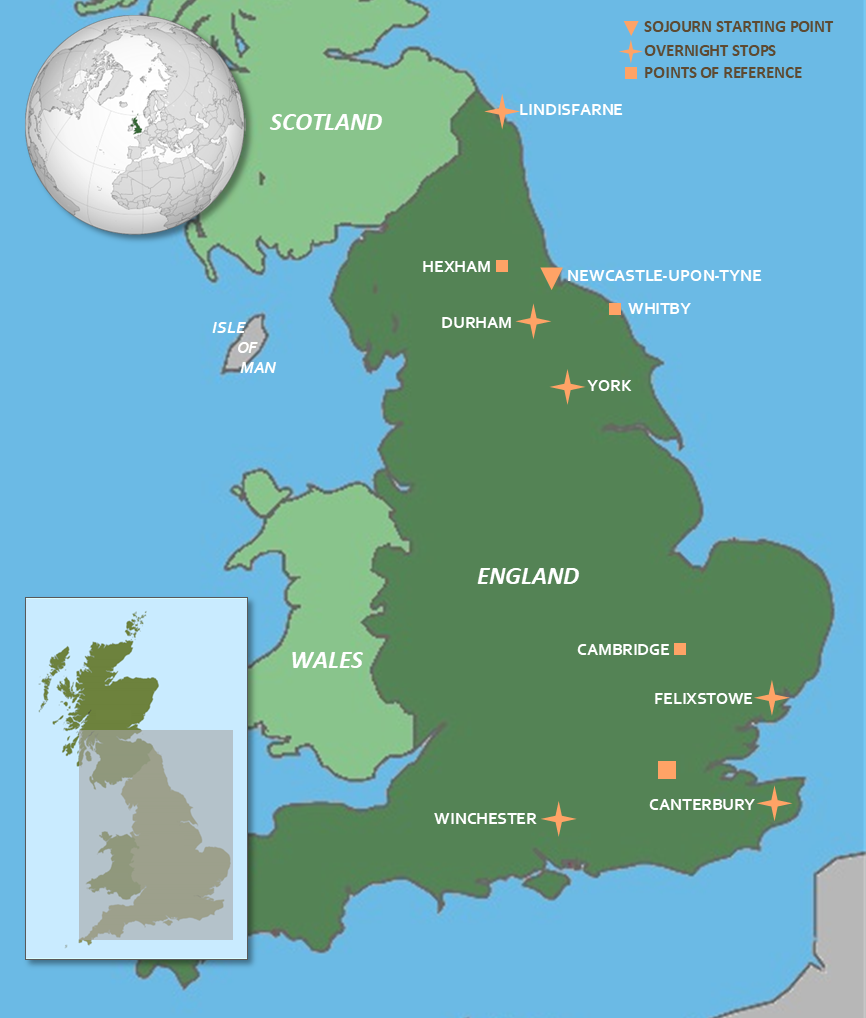
We begin in the North, at Durham, where we examine the immense contributions of the pious Anglo-Saxon holy men St. Cuthbert and St. Oswald, as well as Venerable Bede, the historian and chronicler of Cuthbert. Here we tour the well-preserved Norman Cathedral, which houses the remains of St. Cuthbert, patron saint of Northumbria and early seventh-century bishop of Lindisfarne. The Cathedral also contains the tomb of Bede, a collection of Anglo-Saxon carved stones, and a copy of the Lindisfarne Gospels. A day-long excursion takes us to the sacred site of Holy Island, the location where those remarkable manuscripts were produced in a unique hybrid style formed from a blend of Celtic and Anglo-Saxon elements.
Mimicking ancient religious pilgrimages, we visit a number of sacred sites as we journey down the east coast of England, passing some of the most breathtaking scenery in Britain. Whitby Abbey, an immense, monolithic ruin positioned on the edge of a cliff overlooking the North Sea was the site of the historic Synod of Whitby in 664 chronicled by Bede. Ely Cathedral, built after the Norman Conquest, contains many relics of the original Anglo-Saxon cathedral. Similarly, Canterbury Cathedral, site of the murder of Thomas Becket, also contains a rich Anglo-Saxon history underneath the floor of the Norman structure. During our tour of the Cathedral we learn how continuing excavations reveal the original Saxon structure and underlying Roman road.
Finally, no examination of the Anglo-Saxons would be complete without exploring their significant military endeavors. Near Lindisfarne, we explore Segedumum Roman Fort, the best-excavated fort along Hadrian’s Wall, constructed after Emperor Hadrian in AD 122 ordered a barrier built across Britain to defend the Romans from the Northern Barbarians. Such encounters between the north and south are well-researched thanks to the hoards of equipment found in burial sites such as Sutton Hoo ship burial, where we see helmets, swords, spears, jewelry, and other grave artifacts. We also visit the battlefield at Maldon which is immensely important in the study of Anglo-Saxon history. While the battle ended in defeat, Maldon became the inspiration for a one of the most-celebrated poems in Old English Literature and a battle cry which inspired Anglo-Saxon warriors for decades that followed.
- Professor Drout is a noted expert on Anglo-Saxon literature and is a fluent speaker of both old and middle English
- Visits to the World Heritage sites of Durham Castle, Durham Cathedral, Canterbury Cathedral, and St. Augustine’s Abbey
- Journey to the ancient site of Holy Island with a privately guided tour of Lindisfarne Castle and the remains of Lindesfarne Priory
- Private, guided walking tours of the historic cities of Durham, York, Winchester and Canterbury
- An afternoon visit to the historic fishing village of Whitby, North Yorkshire with a guided tour of the ruins of Whitby Abbey
- Visit to historic Ely Cathedral for a concert of traditional sacred music
- Tours of the historic battlefields at Maldon and Hastings
- Privately guided visits to the reconstructed Anglo-Saxon settlement at West Stow and the Anglo Saxon burial sites at Sutton Hoo


Holy Island


Michael D.C. Drout
Professor English
Wheaton College
 A specialist in both medieval literature and fantasy, Michael Drout is Professor of English and Director of the Center for the Study of Medieval at Wheaton College in Norton, MA. He received his Ph.D. from Loyola University in 1997 and also holds M.A. degrees from Stanford (journalism) and the University of Missouri-Columbia (English literature) and a B.A. from Carnegie Mellon. He was awarded Wheaton’s Faculty Appreciation Award (2002) and Prentice Professorship (2003-2008) for his teaching and has been a Millicent C. McIntosh Fellow of the Woodrow Wilson Institute. Drout is the editor of J.R.R. Tolkien’s Beowulf and the Critics (which won the Mythopoeic Scholarship Award for Inklings Studies for 2003), and the J.R.R. Tolkien Encyclopedia (2007), and is co-editor and co-founder of the journal Tolkien Studies. His many books include How Tradition Works: A Meme-Based Poetics of the Anglo-Saxon Tenth Century (2006), Drout’s Quick and Easy Old English (2012), Tradition and Influence in Anglo-Saxon Literature (2013), and Beowulf Unlocked: New Evidence from Lexomic Analysis (2016). He has also recorded 13 audio programs for The Modern Scholar, including A Way With Words IV: Understanding Poetry, which was a finalist for a 2010 Audie Award. His current research focuses on computer-assisted statistical analysis of texts and has been supported by three grants from the National Endowment for the Humanities.
MICHAEL DROUT ALSO LEADS THIS SOJOURN:


Travel Information
MEETING TIME AND LOCATION:
There are two meeting points for this sojourn: Newcastle upon Tyne rail station and Newcastle Airport. Those making their own travel arrangements should plan to arrive at one of these locations by 12:00 Noon on Sunday, July 26, 2020. You will be greeted here by your Scholarly Sojourns Tour Director who will arrive with the coach that will take you north to Bamburgh where the sojourn will officially begin at approximately 1:30 PM.
OPTIONAL AIR PACKAGE FROM $1,195/PERSON
Our air packages are designed to make all your travel convenient and seamless. They include round-trip, airfare from select North American gateways to Edinburgh, airport transfers in Scotland, and 100% travel assurance.
Recommended Reading:
While no reading is required to fully enjoy this sojourn, the following books will provide you with an excellent foundation:
The Anglo-Saxon Age: A Very Short Introduction
Bede. Ecclesiastical History of the English People
FAQs
Q: What kind of weather can I expect in England in July and August?
Average mid-Summer daytime temperatures in England range from mid-60’s to the upper-70’s, but it can get cooler in the late evenings and night. Rain is less frequent at this time of year than others, but participants are still highly encouraged to bring a lightweight, waterproof jacket or a small umbrella.
Q: Can I arrive before or remain after the sojourn?
Yes. If you would like to arrive at the start location in advance or remain at the end location after the sojourn has concluded, Scholarly Sojourns can help you arrange your hotel accommodation and is often able to secure attractive rates. Please indicate these preferences to us after you have registered for a particular sojourn.
Q: How much walking will be required on this sojourn?
This sojourn involves several tours of historic sites and towns that require walking a considerable distance. All participants should be comfortable walking up to a mile at a time and climbing up to three flights of stairs at a time.
Q: I am a single traveler, can you help me find a roommate?
Scholarly Sojourns will do all we can to match single travelers with a suitable roommate if they desire. But we cannot guarantee that roommates will be available. Therefore all single travelers should register as such and be prepared to pay the single traveler rate should a roommate not be identified.
Q: Is this sojourn appropriate for children?
This sojourn is not appropriate for children. Young adults, however, will find the program quite enjoyable, and they may find it gets them extra credit in their history class.
Anglo-Saxon Britain
DEPARTURE:
Land price per person (double occupancy): $---
Land price per person (single occupancy): $---
Optional air packages from: * $---
Special Offers:
This Sojourn Combines Nicely With:
Land price per person (double occupancy): $3,595
Land price per person (single occupancy): $3,945
Optional air packages from: * $1,195
Special Offers:
Early-Booking Savings: Save $200/Person when you register before 9/30/2022.
Combination Discount: Save $250/Person and receive a transfer between locations when you book consecutive tours.
This Sojourn Combines Nicely With:
*Optional air packages include: round-trip international airfare from select North American gateway, airport transfers at destination, and 100% travel assurance.
Price includes: Eight-day travel program of sightseeing, visits, presentations, and discussions led by Michael Drout; 7 nights accommodation in superior, boutique hotels; 7 breakfasts, 1 lunch, 4 dinners, 2 receptions; excursions and all other activities described in the day-to-day sojourn summary; entrance fees; tour guides; ground transportation; the services of a dedicated Scholarly Sojourns Tour Director who accompanies the group; all gratuities (except for hotel porters).
Price does not include: Airfare; airport transfers; meals not indicated in this detailed itinerary; beverage options other than water, wine, beer, or soft-drinks with group meals; local transportation by bus, taxi, metro or light rail; passport or visa fees and necessary photos; immunizations; excess baggage charges; airport taxes; travel insurance, medical, hospitalization, or evacuation costs; gratuities for hotel porters; laundry; other personal items, including incidental hotel charges; any other item not specifically indicated.
Payment and terms: A non-refundable deposit of $500 per person is due within fourteen (14) days of a confirmed registration. The remaining balance is due 90 days prior to the starting date of the sojourn. For more information, please see our complete Terms & Conditions.


