Go Inside the Most Stunning Medieval Structures in the British Isles
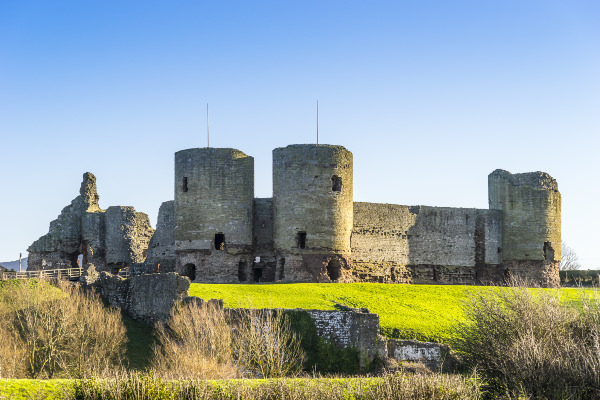
Hundreds of castles—some occupied, many more ruined—survive in the historic British landscape. These structures once served both as military devices and as private homes. Many still dominate town centers. Some are enormous complexes; others little more than eroded earthworks. Each, however, played its role in history, effecting both social and economic change while permanently marking the territory it ruled. And each reveals a fascinating window into the past. Join us on this breathtaking journey through Southern England and Wales as we visit twenty of Britain’s greatest medieval castles and discover the stories they have kept for posterity.

The victory of William I at Hastings marked not only a transition in the ruling class of Britain but also the beginning of a metamorphosis for the Saxon and Welsh landscapes. For in the years directly following their conquest, the Normans and their cohorts turned to feudalism–and the castle–to complete the subjugation of the vanquished. From the late 11th century to the mid-15th century scores of castles were erected across the realm–many over former Anglo-Saxon cemeteries and Roman ruins–as each successive dynasty sought to solidify its control over the Kingdom.
The castle ruins these feudal monarchs left behind provide a fascinating window into the past and remain tangible relics of a chaotic time during which countless lives were turned upside-down as lordly dynasties rose and fell. They expose their builder’s tastes, socio-political power, and sophistication. They reveal an epoch when the masses had to deal not only with warfare and local rivalries but with the very basics of daily survival. They are lasting symbols of an era of strife and social status, of political mayhem, and cultural evolution. Regardless of their size or condition, each provides a unique glimpse into history.
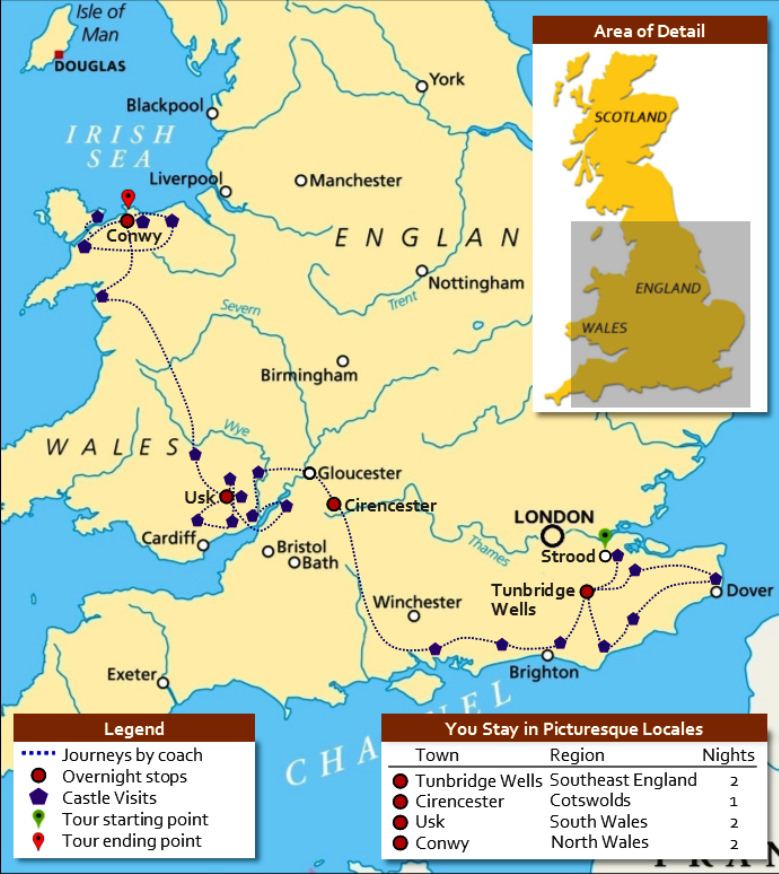
Our journey begins in Southeastern England where we explore the impressive remains of Rochester castle, a Norman fortress built in 1127 by William of Corbiel, Archbishop of Canterbury, to guard a strategic crossing over the River Medway. Further exploration takes us to Dover Castle–perched atop the iconic white cliffs along the sea–one of most impressive and quintessential castles in all of Britain. Here we find structures from virtually every era of British history, as well as elements from prehistory, the Roman era, and the Anglo-Saxon occupation of the site. The remarkably well-preserved castle was used almost continuously until the Cold War, and was in fact a key staging point during World War II. The great keep erected by Henry II, arguably the most impressive of its kind, has recently been restored to its presumed medieval state.
From Dover we journey west across Southern England stopping at the majestic castles of Arundel and Lewes. At Pevensey in East Sussex we encounter a castle directly associated with the Norman invasion. Built just after the conquerors landed, this example of earth-and-timber architecture was erected inside the ruins of the prior Roman fort and reveals a key strategy of the new rulers – by building over many earlier sites, the Normans put forth a psychological message that they had conquered Britain and they had no intention of backing away.
Continuing west, we explore many remarkable sites in beautiful Southwestern England and South Wales. At Berkeley Castle – one of Britain’s oldest continuously-inhabited castles and the site of the imprisonment and murder of Edward II – we are provided an exclusive presentation on the structure’s history by the castle archivist and, if we are lucky, we enjoy a brief visit with the castle’s current resident, Charles Berkeley. At Caerphilly we encounter the first fully concentric castle in Britain–consisting of a complex of stone and water defenses, it was modeled on mighty Kenilworth Castle, which we explore later on our tour. And at Raglan we see one of the last great fortresses erected in Britain; an imposing structure which held its own against the bombardment of cannon balls during the English Civil War. Today, its polygonal towers and machicolations welcome visitors into a complex of ruins that represent the essence of castle life – from the kitchen range to the state apartments, and from the powerful Yellow Tower of Gwent to the great keep with its fascinating apron and water-filled moat.
Heading north, we explore the constructions of Britain’s greatest castle-building king, Edward I (Longshanks), who was inspired to erect monumental fortresses in North Wales (as well as transform the likes of the Tower of London) for several very personal reasons. Here we encounter atmospheric medieval towns that are directly associated with a castle, some of which are enclosed by sturdy, towered, stone walls that extend from castle’s fortifications. Fine examples of these include the Conwy town wall, which is walkable along its entire 3/4 mile distance, and the Caernarfon wall which is also accessible at many points. Along with Harlech and Beaumaris, these remarkably well-preserved structures and their associated castles are included on UNESCO’s World Heritage List as “the finest examples of late 13th century and early 14th century military architecture in Europe, as demonstrated through their completeness, pristine state, evidence for organized domestic space, and extraordinary repertory of their medieval architectural form.” Together they are designated as the “Castles and Town Walls of King Edward in Gwynedd.”
Along the way, our sojourn leader brings the history of the castle to life, pointing out the unique features of the structures and impressing upon us the purposes each served. We discover not only the reason why castles have captured the imagination of tourists for centuries, but also why archaeologists and historians continue to examine castle remains. These tangible relics reveal a remarkable past, a lengthy heritage etched in stone as well as with the blood and sweat of those who built, labored, fought, and died in their shadow. They stir in us a profound awareness of those lives and they impart a timelessness that inspires awe no matter their condition. The story of just how so many of these remarkable structures came to be is every bit as fascinating. That medieval castles have endured centuries of warfare and the effects of weather is a testimony to the creativity and power of their medieval builders. How many of our modern-day edifices will leave such long-lasting legacies?
- Your sojourn leader, Paul Remfry, is a noted scholar, castle historian, and widelypublished author who has spent his entire professional life researching the castles of England and Wales
- Experience in-depth tours of 20 of the most significant and stunning castles in the British Isles
- Drive through the heart of Wales from South to North and experience its diverse beauty
- Two nights in the charming village of Usk in stunning Monmouthshire, South Wales
- A private tour of Berkeley Castle conducted by its future resident—Charles Berkeley—himself
- Privately guided tours of the UNESCO World Heritage Sites of the Castles and Town Walls of King Edward in Gwynedd
- Two nights in the historic, walled town of Conwy, Wales—a UNESCO World Heritage Site
- An afternoon drive through the breathtaking mountain scenery of Snowdonia National Park
- Visit the beautiful Wye River Valley and see the ruins of famed Tintern Abbey
- Scholarly Sojourns signature picnic lunches in the stunning gardens of Arundel Castle and inside the ancient walls of Caldicot Castle


Tunbridge Wells


Paul Martin Remfry
Author & Historian
 Your tour leader, Paul Remfry, is arguably one of the greatest castle scholars of our era. He is a meticulous researcher who has spent over 30 years studying medieval history, genealogy, and architecture. As an historian with a passion for telling the stories of castles and the people who once lived in them, Remfry lectures throughout the United Kingdom and also frequently appears as an expert on television documentaries exploring the history of castles. He has also written extensively about castles, abbeys, and battles and his list of published works now includes some 20 books and over fifty booklets and scholarly articles for academic and archaeological journals. His scholarship, particularly on the castles of Wales and the Marshes is widely praised as superlative and his research approach to the study of castles has garnered widespread acclaim from the academic community.
PAUL REMFRY ALSO LEADS THESE SOJOURNS:
GREAT CASTLES OF SCOTLAND
GREAT CASTLES OF IRELAND
LOST CASTLES OF WALES


Travel Information
MEETING TIME AND LOCATION:
The meeting point for this sojourn is Strood Railway Station in Strood, England, which is just across the River Medway from Rochester where the tour begins. Those making their own travel arrangements should plan to arrive here by 2:00PM on Sunday, October 11th. You will be greeted by your Scholarly Sojourns Tour Director who will assist you with boarding the coach. An optional shuttle will also be offered from London Heathrow Airport Terminal 3, departing at 1:00PM that day.
OPTIONAL AIR PACKAGE FROM $1,199/PERSON
Our air packages are designed to make all your travel convenient and seamless. They include round-trip, airfare from select North American gateways, airport transfers, and 100% travel assurance.
Recommended Reading:
While no reading is required to fully enjoy this sojourn, the following books will provide you with an excellent foundation:
Understanding the Castle Ruins of England and Wales: How to Interpret the History and Meaning of Masonry and Earthworks.
Hull, Lise. McFarland. 2008.
The Great Castles of Britain & Ireland
Hull, Lise. New Holland Publishers, Ltd., London. 2006.
FAQs
Q: What kind of weather can I expect in England in October?
Average daytime temperatures in June range from Low-50’s to mid-70’s, but it can get cooler in the late evenings and night. Rain can be frequent at this time so participants are encouraged to bring a lightweight, waterproof jacket or a small umbrella.
Q: Can I arrive before or remain after the sojourn?
Yes. If you would like to arrive at the start location in advance or remain at the end location after the sojourn has concluded, Scholarly Sojourns can help you arrange your hotel accommodation and is often able to secure attractive rates. Please indicate these preferences to us after you have registered for a particular sojourn.
Q: How much walking will be required on this sojourn?
This sojourn involves several tours of historic monuments and towns that require walking and climbing a considerable distance. Several of the castles ruins we visit have uneven floors and narrow, winding staircases. All participants should be comfortable walking up to a mile at a time and climbing up to three flights of stairs at a time. In a few instances, it is necessary to climb upwards of 75 stairs to see every part of a monument.
Q: I am a single traveler, can you help me find a roommate?
Scholarly Sojourns will do all we can to match single travelers with a suitable roommate if they desire. But we cannot guarantee that roommates will be available. Therefore all single travelers should register as such and be prepared to pay the single traveler rate should a roommate not be identified.
Q: Is this sojourn appropriate for children?
This sojourn is not appropriate for children. Young adults, however, will find the program quite enjoyable, and they may find it gets them extra credit in their history class.
Great Castles of the British Isles
DEPARTURE:
Land price per person (double occupancy): $---
Land price per person (single occupancy): $---
Optional air packages from: * $---
Special Offers:
This Sojourn Combines Nicely With:
Land price per person (double occupancy): $7,090
Land price per person (single occupancy): $8,285
Optional air packages from: * $1,199
Special Offers:
Combination Discount: Save $250/Person and receive a transfer between locations when you book consecutive tours.
This Sojourn Combines Nicely With:
*Optional air packages include: round-trip international airfare from select North American gateway, airport transfers at destination, and 100% travel assurance.
Price includes: Fifteen-day travel program of sightseeing, castle tours, presentations, and discussions led by Paul Remfry; 14 nights accommodations; 14 breakfasts, 4 lunches, 8 dinners, 6 receptions; the services of a dedicated Scholarly Sojourns Tour Director who accompanies the group; ground transportation; entrance fees; gratuities (except for hotel porters); all other activities described in the day-to-day summary.
Price does not include: Airfare; airport transfers; meals not indicated in this detailed itinerary; beverage options other than water, wine, beer, or soft drinks with group meals; local transportation by bus, taxi, metro or light rail; passport or visa fees and necessary photos; immunizations; travel insurance; excess baggage charges; airport taxes; medical, hospitalization, or evacuation costs; gratuities for hotel porters; laundry; other personal items, including incidental hotel charges; any other item not specifically indicated.
Payment and terms: A non-refundable deposit of $500 per person is due within fourteen (14) days of a confirmed registration. The remaining balance is due 90 days prior to the starting date of the sojourn. For more information, please see our complete Terms & Conditions.