A Spectacular Journey through Southwestern France
The evocative region of southwestern France has had a long and deeply-entrenched specific regional character which sets it apart. But it was an enigmatic sect of Christians here that thrust this area onto the world stage when they proved to be a threat to the established Church in the Middle Ages. Known as Cathars, they held an unorthodox set of beliefs and their practices quickly became anathema to the guardians of Roman Catholicism. Join us to explore the Cathars and the Catholic Church’s crusade against them as we journey directly into the heart of the Cathar homeland–a verdant region dotted with fairytale-like citadels at the base of the Pyrenees known as the Languedoc.
For most of the Middle Ages, the Roman Catholic Church and its theological teachings and traditions were the single most unifying force in all of Western Europe. While the common people suffered centuries under the burden of unpredictable local rulers, arduous manual labor, and the constant threat of invasion, the Catholic Church’s promise of heavenly rewards for living in accord with the established doctrine provided much comfort and hope to help masses endure their daily hardships. Even so, over centuries, a number of Christian sects would emerge that presented challenges to the Church’s supremacy and, quite often, were at direct odds with its practices and teachings. Among these sects, perhaps the most fascinating and enigmatic of them all were the Cathars of southwestern France.
The region of southwestern France known as the Languedoc had a unique regional character in the Middle Ages. Land husbandry, the independent attitude of its nobility towards the French crown, and even the spoken word (the langue d’oc dialect that gave rise to the region’s name) all seemed slightly at odds with the rest of France. Strong local traditions of food, poetry, and music contributed to its individual cultural character, but what brought it to the attention of the established Church was the unorthodox and widely-practiced religion of the Cathars. The Cathar faith (or Albigensianism, as it also came to be known owing to its strength in the region around the city of Albi), was a form of Christianity but with a set of beliefs and practices regarded as heretical to the authorities and guardians of Roman Catholicism. The 13th century was to see a crusade against the Cathars that was no less brutal than those carried out against the so-called ‘infidel’ in the East. In fact, so devastating was this crusade and the Inquisition that would follow that the Cathars and their faith were forced underground and eventually eradicated. While the historical records that we have about the Cathars were written by the victors of this inter-faith conflict, the Inquisition Court depositions have nevertheless bequeathed the means of reconstructing a very full picture of the daily life and practices of the devotees of this obscure faith, who simply called themselves “Good Christians” and their priests “Good Men” or “Good Women.”
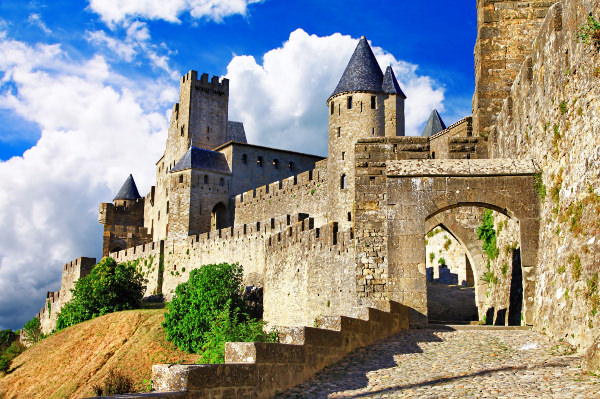
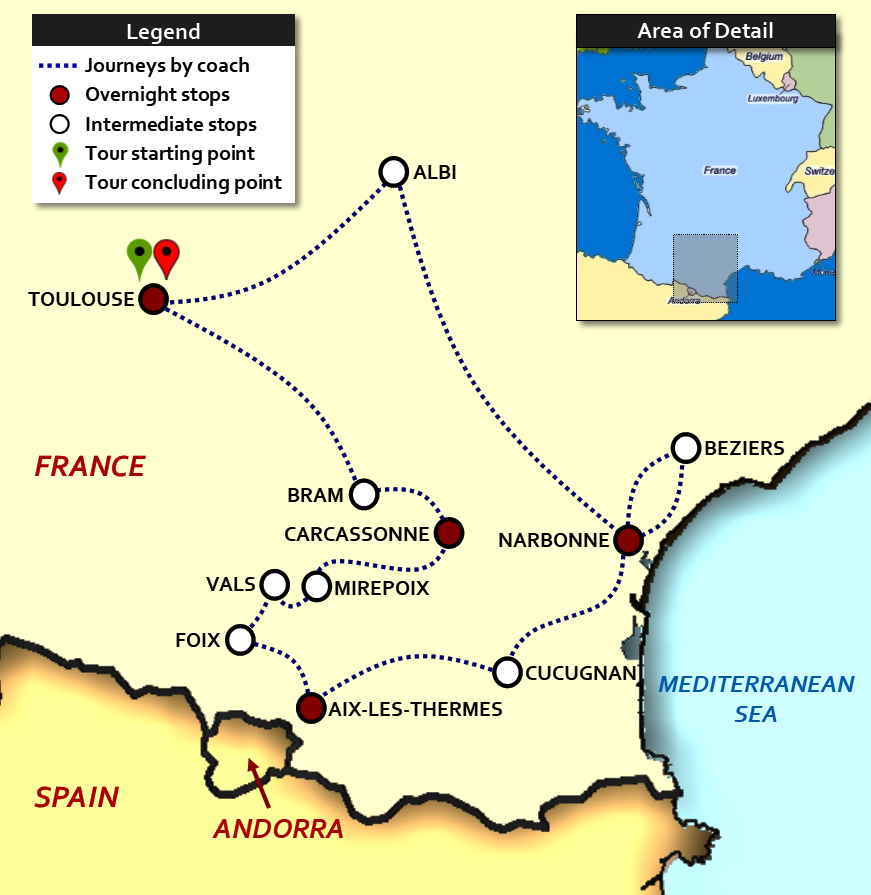
Who exactly were the Cathars, and how and why were their set of beliefs and practices so threatening to the established Church orthodoxy of the time that the pope felt it necessary to call for a crusade to eradicate fellow Christians? What other issues were at play? These are central questions that we will explore as we set out across the Languedoc region of southwestern France. Starting in the prominent medieval city of Toulouse, a city that was the seat of the most powerful count in the Midi region of southern France whose church architecture reflects not only the city’s preeminent status but also its place in early Christian history, we begin an investigation into the Cathar religion and its relationship with the established Catholic Church. From Toulouse, we move on to Albi, the city that gave Catharism its other name and the crusade that was launched against it—the Albigensian Crusade. As we head south, we shall walk in the very footsteps of these “heretics” that the Catholic Church and the state authorities were so determined to eliminate, and the crusaders who were sent to root them out. Along the way, we discover the kinds of settlement that became centers of Catharism. These fortified towns, with dozens of lesser villages en route, are set within the stunning backdrop of the Midi landscape, bordering on the shimmering waters of the Mediterranean Sea and the awe-inspiring mountains of the Pyrenees. We shall also sample the castle architecture that has become so connected with the story of the Cathar’s struggle with visits to chateaux that exemplify the siting of Cathar strongholds at Queribus, Peyrepertuse, Montsegur, Foix, and Carcassonne. The majority of these sites bore witness to the horror of what defeat meant, as appalling atrocities were inflicted upon the vanquished by the merciless conquerors—the stories of each we learn about as we move from place to place.
Join us on this once-in-a-lifetime, alluring sojourn that traverses the beautiful landscapes of southwestern France in search of attaining a heightened understanding of these devoted but unorthodox Christians. A people who held their beliefs so dear that they were willing to oppose the overweening power of the Church and sacrifice their very lives rather than abandon their creeds.
- See the UNESCO World Heritage Sites of Albi and Carcassonne
- A night in the picturesque spa village of Ax-les-Thermes, nestled in the Pyrenees Mountains where the rivers Oriege, Ariege, and Lauze converge
- Two days exploring the stunning ancient city of Toulouse, the capital of the Haute-Garonne region of southwestern France
- A Scholarly Sojourns signature picnic in the stunning Languedoc countryside
- A visit to the magnificent Church of St. Sernin—the largest Romanesque-style church in Europe—which contains an array of high-quality Romanesque sculpture
- Two nights in the stunning, fortified walled-city of Carcassonne
- In-depth explorations of five fairy-tale-like Cathar castles, including the breathtaking Chateau de Montesegur—the last Cathar Castle to fall during the Albigensian Crusade
- A visit to the charming town of Albi—which gave its name to the crusade set against the Cathars—beautifully set on the banks of the Tarn River
- A guided tour of historic Abbaye de Fontefroide, a beautifully-restored, 11th-century abbey that is indelibly linked to the Albigensian Crusade


Toulouse | 1 Night


Paul Martin Remfry
Author & Historian
 Your tour leader, Paul Remfry, is arguably one of the greatest castle scholars of our era. He is a meticulous researcher who has spent over 30 years studying medieval history, genealogy, and architecture. As an historian with a passion for telling the stories of castles and the people who once lived in them, Remfry lectures throughout the United Kingdom and also frequently appears as an expert on television documentaries exploring the history of castles. He has also written extensively about castles, abbeys, and battles and his list of published works now includes some 20 books and over fifty booklets and scholarly articles for academic and archaeological journals. His scholarship, particularly on the castles of Wales and the Marshes is widely praised as superlative and his research approach to the study of castles has garnered widespread acclaim from the academic community.
PAUL REMFRY ALSO LEADS THESE SOJOURNS:
GREAT CASTLES OF BRITAIN
GREAT CASTLES OF IRELAND
LOST CASTLES OF WALES


Travel Information
MEETING TIME AND LOCATION:
The meeting point for this sojourn is Hotel Albert 1er in Toulouse, France. Participants making their own travel arrangements should plan to arrive here between 11:00 and 13:00 on the first day of the sojourn. The first official sojourn activity begins at 14:00 that day.
OPTIONAL AIR PACKAGE FROM $1,199/PERSON
Our air package includes round-trip, trans-Atlantic flight, airport transfers in the destination, and 100% travel assurance. This travel package can be booked once you have registered for this sojourn and paid the deposit of $500 per traveler. Scholarly Sojourns can arrange your travel from any North American gateway.
FAQs
Q: What kind of weather can I expect in Southwestern France in June?
Average daytime temperatures will range from high-70’s to low-90’s. Rain is fairly infrequent at this time, but participants may wish to bring a lightweight, waterproof jacket or a small umbrella just in case.
Q: Can I arrive before or remain after the sojourn?
Yes. If you would like to arrive at the start location in advance or remain at the end location after the sojourn has concluded, Scholarly Sojourns can help you arrange your hotel accommodation and is often able to secure attractive rates. Please indicate these preferences to us after you have registered for a particular sojourn.
Q: How much walking will be required on this sojourn?
Many of the sites we visit require uphill walks of approximately one-half mile. Most of these have a fairly moderate incline, but a few do get steep in sections. In general, participants should feel comfortable walking up to a mile at a time and be capable of climbing up to three flights of stairs at a time.
Q: I am a single traveler, can you help me find a roommate?
Scholarly Sojourns will do all we can to match single travelers with a suitable roommate if they desire. But we cannot guarantee that roommates will be available. Therefore all single travelers should register as such and be prepared to pay the single traveler rate should a roommate not be identified.
Q: Is this sojourn appropriate for children?
This sojourn is not appropriate for children. Young adults, however, will find the program quite enjoyable, and they may find it gets them extra credit in their Art History class.
Castles in the Clouds
DEPARTURE:
Land price per person (double occupancy): $---
Land price per person (single occupancy): $---
Optional air packages from: * $---
Special Offers:
This Sojourn Combines Nicely With:
*Optional air packages include: round-trip international airfare from select North American gateway, airport transfers at destination, and 100% travel assurance.
Price includes: Complete, guided tour program of sightseeing, presentations, discussions, and visits, 7 nights hotel accommodation, all breakfasts and other meals as per itinerary, 2 cocktail receptions, all entry fees, private guides, ground transportation, water transportation, all gratuities except porterage, and all sojourn activities as detailed in the compete itinerary.
Price does not include: Airfare (unless noted otherwise); airport transfers; meals not stated in the complete itinerary; beverages options other than wine, beer, or soft-drinks with group meals; passport or visa fees and necessary photos; immunizations; travel insurance; excess baggage charges; airport taxes; medical, hospitalization or evacuation costs; gratuities for porterage; laundry and other personal items.
Payment and terms: A non-refundable deposit of $500 per person is due within fourteen (14) days of a confirmed registration. The remaining balance is due 90 days prior to the starting date of the sojourn. For more information, please see our complete Terms & Conditions.